

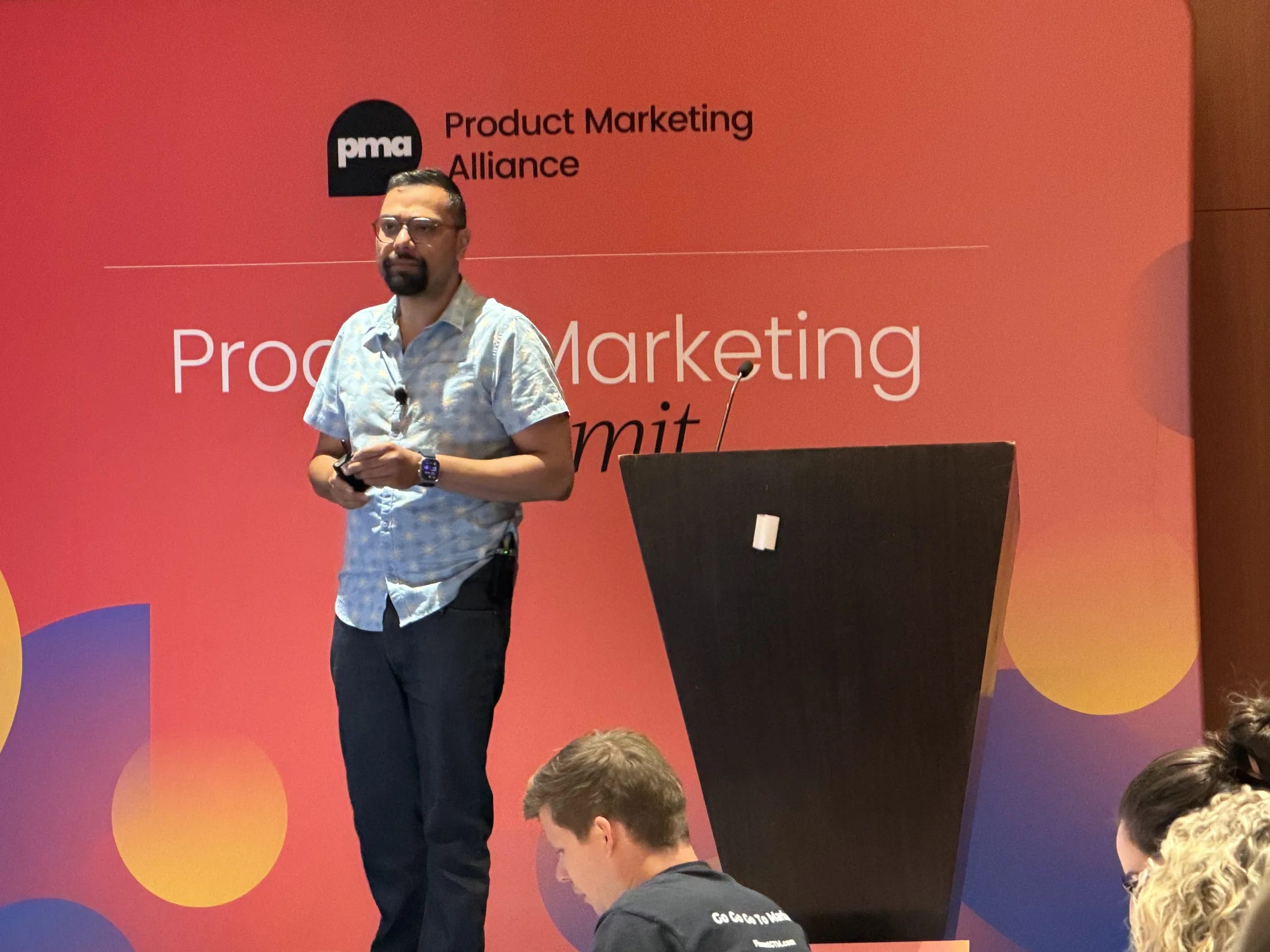
On June 18, I gave a main-stage talk at Product Marketing Summit Seattle about AI agents as GTM copilots. One slide didn't make the final deck. It probably should have. I called it the legitimacy gap.
It goes like this.
When you launch a new product, buyers need to believe three things at once. One, that the problem you're solving is real. Two, that your solution actually works. Three, that you, specifically, are the right company to trust with it.
For most products, you're fighting on one or two of those. For AI products right now, all three are contested simultaneously. Buyers are questioning whether the problem is even real (because they've been told AI solves everything, and most of them have been burned by that). They're questioning whether solutions work in production, not just in demos. And they're questioning whether any company in this space has earned enough trust to be worth the organizational disruption of deploying it.
That's a hard room to walk into. And most AI positioning I see tries to solve all three with one message.
It doesn't work. Because the buyer's objections aren't one thing. They're three things, in a specific order. And if you don't address them in that order, you lose the room before you earn the next point.
The answer isn't three separate messages. It's a narrative arc. Problem legitimacy first. Then proof the solution works under conditions like theirs. Then trust, which is almost always earned through specifics, not through claims.
I'm still working out a longer version of this. But if you're heading into a positioning cycle for an AI product in the back half of this year, I'd start with the legitimacy question, not the feature list.
More coming from this as I turn the talk into something publishable.
Kuber
Most of what I write here leans on four frameworks, all published in full at kubersharma.com with nothing gated. The Pilot Trap is why enterprise AI that works in a demo still dies before production. If you run a marketing team and are arguing about what AI gets to decide on its own, that argument is The Augmented Marketing Decision Architecture. The Trust Architecture is the three layers of trust a buyer needs before they will deploy, and The Belief Bridge is how you get them there.