

Your agents are excellent. They are also incoherent.
Most enterprise teams I've spoken with have agents running. Plural. A support agent. A deal summary agent. A compliance check agent. Sometimes an agent for scheduling that nobody asked for. Many of them work well in isolation. They each have their own memory, their own context, their own rules for handing off to a human when something goes sideways.
What they don't have is orchestration.
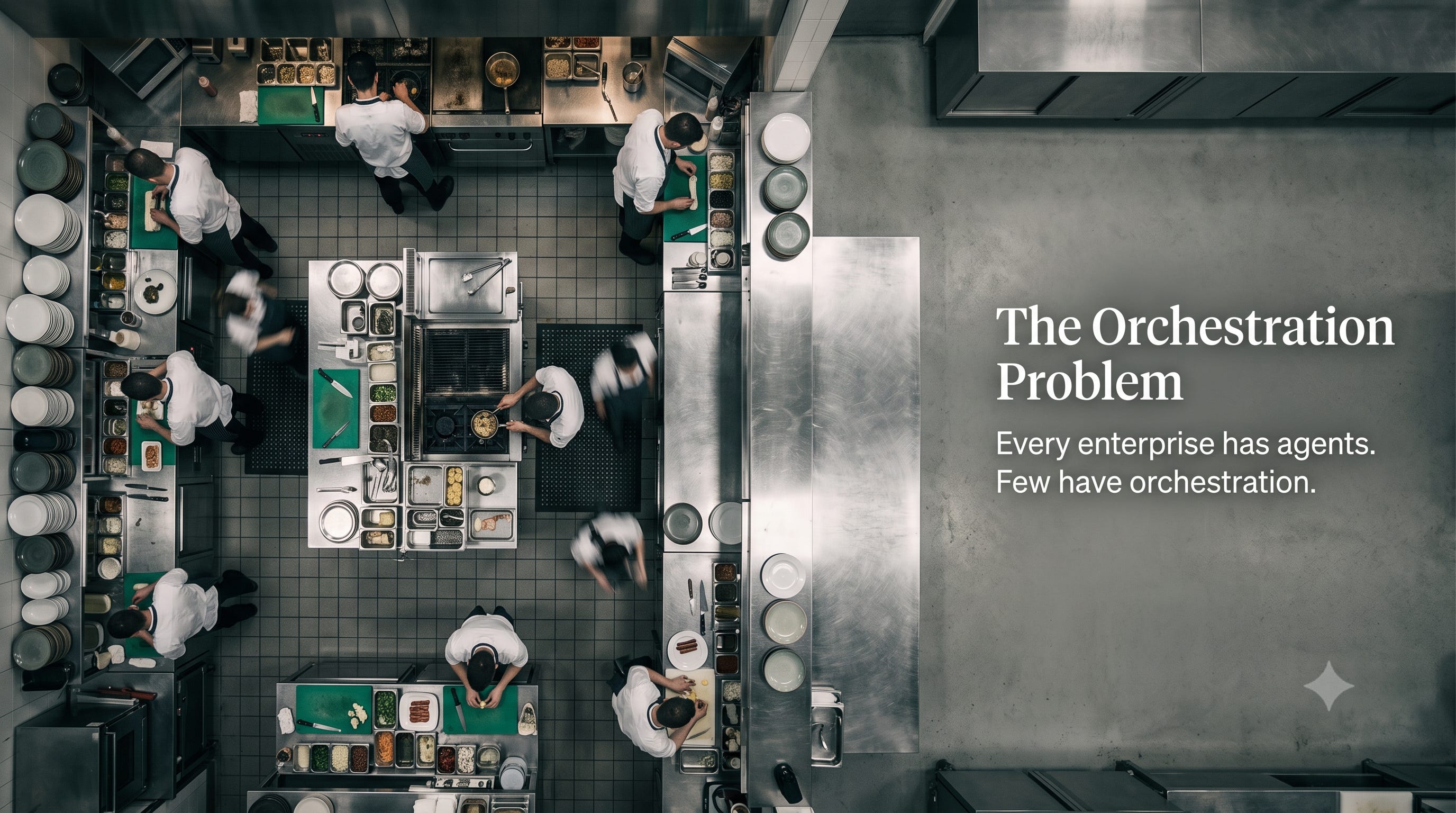
Think about a kitchen at a restaurant. A line cook can be excellent at their station. But if nobody is calling tickets, if nobody knows what's on the pass, if nobody is tracking how long Table 7 has been waiting, excellent line cooks produce excellent chaos.
That's what most enterprise AI deployments look like right now. Individually capable. Collectively incoherent.
The fix isn't a governance committee. It's not a new platform. It's a shared spine. A way for agents to share context, hand off with memory intact, and escalate to a human who actually knows what's happening across the system, not just at one station.
Two standards are worth watching. MCP standardizes how agents access tools, data, and context. Agent2Agent (A2A) focuses on how agents connect and collaborate across systems. Neither gives an enterprise a complete orchestration layer by itself. But together they point toward a future in which every new agent doesn't require another bespoke set of integrations and handoff rules.
My read: the organizations that figure out the orchestration layer in the next six months will build an advantage that compounds quickly. Because by then, the hard part won't be getting one agent to work. It'll be getting ten agents to work together.
If you're positioning AI products right now, this is the argument worth making. Not "our agent is smarter." The smarter play is: here's how all of it holds together.
That's the fight worth having.
Kuber
Most of what I write here leans on four frameworks, all published in full at kubersharma.com with nothing gated. The Pilot Trap is why enterprise AI that works in a demo still dies before production. If you run a marketing team and are arguing about what AI gets to decide on its own, that argument is The Augmented Marketing Decision Architecture. The Trust Architecture is the three layers of trust a buyer needs before they will deploy, and The Belief Bridge is how you get them there.